

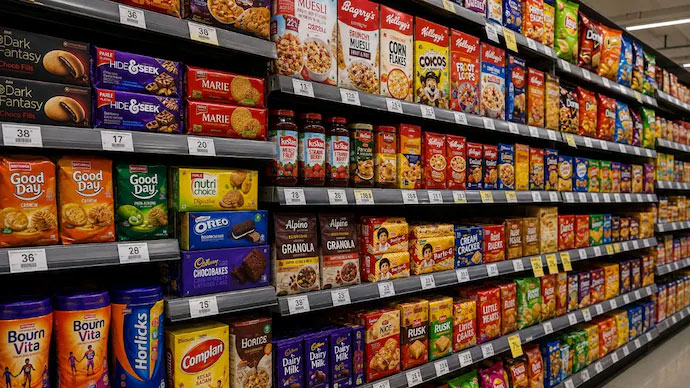
The Supreme Court slammed the Food Safety and Standards Authority of India (FSSAI) over a delay in introducing warning labels on packaged foods and asked if the government “does not want its people to be healthy”.
The top court was hearing a PIL of public charitable trust 3S and Our Health Society seeking directions to the Centre, states and Union territories to implement mandatory front-of-package warning labels (FOPL) on packaged foods.
A bench comprising Justices J B Pardiwala and K Vinod Chandran said FOPL labels are necessary to create awareness, especially among growing children who are becoming addicted to junk food.
It took exception to the FSSAI’s apparent reluctance over the proposal and questioned why a measure aimed at improving public awareness was being delayed.
“Are you taking the court for a toss?” the Bench asked, while alleging that pressure from food manufacturers could be influencing the regulator’s approach.
The court made it clear that the issue was not about targeting any particular food product or manufacturer, but ensuring that consumers have adequate information before making their purchasing choices.
“What have you done so far? We know the pressure on you. Will you do it on your own or should we pass an order?” the bench queried.
The Centre and FSSAI have been given two weeks to place their final decision on the issue before the Supreme Court.
The matter relates to a PIL on front-of-pack labelling for foods containing high levels of sugar, salt and fat. The Supreme Court had earlier asked the FSSAI to examine the issue and consider appropriate measures.
Additional Solicitor General Brijender Chahar, appearing for the Centre and FSSAI, argued that applying such warning labels could create difficulties because several traditional Indian foods naturally contain relatively high amounts of salt or fat.
Failing to be convinced, the bench asked, “You don’t want people of this country to remain healthy? More particularly growing children?”
The court also questioned why manufacturers’ commercial interests should become a factor in deciding whether consumers receive such information.
“Manufacturers may not like this because it may affect their business,” the Bench observed, while pointing out that consumers would still retain the choice of whether to buy a product carrying a warning.
The FSSAI had earlier indicated that there was no consensus on the proposed labelling framework.
Its expert committee considered the Indian Nutrition Rating system and received more than 14,000 comments from stakeholders, after which further research and consultations were being considered.