

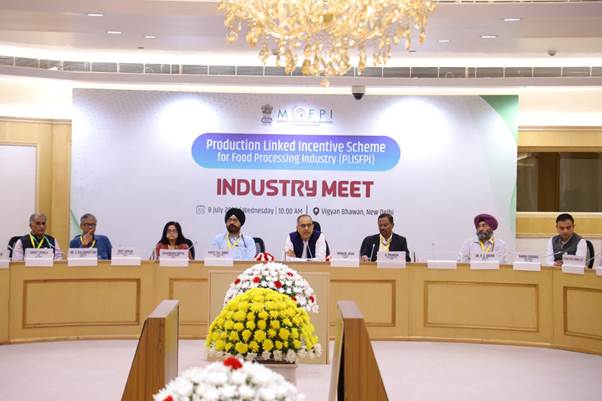
The Ministry of Food Processing Industries (MoFPI), Government of India, today organized a high-level Stakeholder Consultation at Vigyan Bhawan, New Delhi, to deliberate on the future roadmap for fiscal support to the food processing sector and to formulate the next phase of the incentive/ subsidy schemes.
The consultation brought together senior officials of the Ministry, representatives of IFCI Limited, Invest India, industry leaders, sectoral associations and beneficiaries of the PLISFPI scheme. The objective was to obtain structured industry feedback on the design, scope, implementation framework and incentive architecture for the proposed expansion of the scheme.
The meeting commenced with a presentation highlighting the significant achievements of the existing PLISFPI. Against the originally committed investment of ₹7,722 crore, beneficiary companies have reported investments exceeding ₹9,207 crore across 212 manufacturing locations in 22 States, surpassing initial commitments by nearly 20 percent. Sales of PLI-supported products have grown at a CAGR of 10.82 percent, increasing from ₹58,758 crore in FY 2019-20 to ₹1,08,854 crore in FY 2025-26, while exports registered a CAGR of 11.05 percent, reaching ₹20,840 crore during the same period. The scheme has also generated approximately 3.35 lakh direct and indirect employment opportunities and facilitated investments of over ₹3,265 crore in notified tribal areas. A notable outcome has been the remarkable growth in millet-based processed foods, with sales growing at a CAGR of 104 percent and millet procurement increasing at a CAGR of 97 percent.
Delivering the keynote address, Shri Avinash Joshi, Secretary, Ministry of Food Processing Industries, emphasized that the Government is committed to building an evidence-based, industry-driven framework for the next generation of food processing incentives. He stated that the future policy architecture would focus on strengthening domestic manufacturing, enhancing India’s global competitiveness, promoting innovation and technology adoption, encouraging value addition and ensuring greater benefits for farmers, MSMEs and agri-value chains.
Sector-specific deliberations were held across major food processing segments including Ready-to-Cook/Ready-to-Eat Foods, Bakery and Confectionery, Processed Fruits & Vegetables, Beverages and Spices, Marine Products, Dairy, Nutraceuticals, Functional Foods, Plant-Based Proteins, Animal Feed and Food Processing Machinery.
Industry representatives broadly recommended that the next phase of the scheme should adopt a more flexible and outcome-oriented incentive framework. Suggestions included broadening the scheme’s coverage to encompass emerging food categories, introducing differentiated incentive structures based on strategic objectives such as exports, import substitution, research and development, innovation and technology adoption and linking incentives with employment generation and capital investment.
Participants also highlighted the need to strengthen support for overseas branding and marketing, improve reimbursement mechanisms, facilitate backward integration for critical raw materials, simplify implementation processes, rationalize eligibility criteria and encourage automation, quality enhancement and product innovation. Special emphasis was laid on promoting nutraceuticals, functional foods, plant-based proteins, dairy ingredients, marine value-added products, animal feed, pet food and advanced food processing technologies as sunrise sectors with significant domestic and export potential.
The consultation further underscored the importance of creating a globally competitive innovation ecosystem through dedicated research infrastructure, clinical validation facilities, Centres of Excellence, export promotion initiatives and regulatory support. Industry also advocated greater policy support for import substitution, development of indigenous ingredients, strengthening supply chains and promoting globally competitive Indian food brands.
The meeting concluded with a summary of key recommendations by Invest India, followed by closing remarks from Secretary, MoFPI. He has emphasized that the Government’s intent to adopt a focused, collaborative and action-oriented approach with distinct objectives such as constitution of Working Groups i.e. the 1st Working Group to address the growing misleading and negative perception relating to processed food products and the broader food processing sector and 2nd Working Group to adopt a focused, collaborative and action-oriented approach towards strengthening and promoting India’s food processing sector. The Groups has an important responsibility not only in promoting the processed food products, but also in developing a positive, science-based and growth-oriented narrative for the sector as per the scope of work prescribed for the working groups. He assured all stakeholders that the Ministry would carefully examine the recommendations received and continue working in close partnership with industry to develop a transparent, progressive and future-ready policy framework. He reiterated the Government’s commitment to making India a global hub for food processing by fostering innovation, enhancing competitiveness, strengthening value chains and creating sustainable employment opportunities across the sector.